
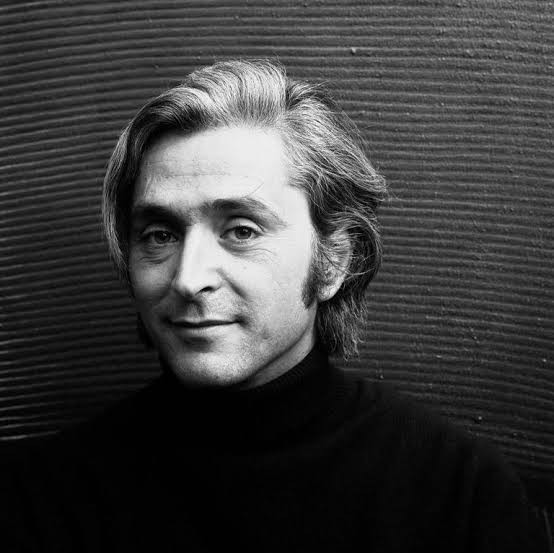
Domenico Gnoli
Rent or buy art by Domenico Gnoli? At Kunstuitleen.nl you can view work by Domenico Gnoli and try it free at home — with delivery and a hanging service throughout the Netherlands.
Domenico Gnoli (Rome, May 3, 1933 – New York, April 17, 1970) was an Italian painter, illustrator, and set designer. He is known for his hyperrealistic close-up depictions of details from everyday objects.
Childhood and Education
Gnoli was born in Rome in 1933, the son of Annie de Garrou (1900–1994), a painter and ceramicist from a noble family, and Umberto Gnoli (1878–1947), an art historian and director general of the Umbrian Museum of Art History, a descendant of a family of poets and art historians. His sister Marzia was born the following year. They spent their childhood in Rome and Spoleto.
The family environment, with its strong emphasis on art and culture, fostered Gnoli’s passion for drawing and painting from an early age.[4][5] At the age of 10, his father introduced him to architecture.
He took classes in drawing and etching with Carlo Alberto Petrucci and, as early as December 1950—at the age of 17—was able to exhibit at the Galleria Cassapanca in Rome[6] with a series of graphic works titled “Mes Chevaliers.”
Theater
The following year, in 1951, he participated in a group exhibition of graphic art titled “Art graphique italien contemporain” at the Galerie Giroux in Brussels. In 1952, he exhibited etchings and drypoint works at the Second Italian Engraving Exhibition in Sassari.[8] Between 1951 and 1955, however, it was primarily the theater that captured his attention. In 1951, he designed the poster for a theatrical adaptation of the book “Chéri” by the French writer Colette.[7] In 1952, he began studying set design at the Academy of Fine Arts in Rome, but dropped out almost immediately to join the Capodaglio–Pilotto–Carraro–Miserocchi theater company as an actor.[8] He also landed a role in Blasetti’s film “La fiammata.”[9] He designed sets and costumes for various theater companies in Italy and Switzerland.
Between Paris and London
In 1953, he moved to Paris and became part of the circles of the Paris School and so-called decadent artists, such as Ernest Fuchs and Friedensreich Hundertwasser, whom he greatly admired.
Jean-Louis Barrault commissioned him to design the sets and costumes for Jules Supervielle’s *La belle au bois dormant*. Although this production was never staged, Barrault was very impressed with the sketches Gnoli had created and wrote a letter of introduction to Laurence Olivier, co-director of the “Old Vic” in London. This opened the doors to the London theater scene for Gnoli.[8] Meanwhile, he was invited to participate in the exhibition “Contemporary Italian Painters” at the Sagittarius Gallery in Philadelphia, where he exhibited imaginative drawings inspired by the theater.[8] At the “Old Vic,” he successfully designed the sets and costumes for the productions of “As You Like It,” directed by Robert Helpmann.[7] Despite his promising career as a set and costume designer, Gnoli found no fulfillment in the theater world; he struggled particularly with teamwork.[11] He decided to leave the theater to devote himself to painting.
Between New York and Europe
In 1955, he moved to New York. He painted and experimented with mixed media, using tempera and sand. Influenced by Morandi and Carrà, he became involved with Pittura metafisica,[8] the Italian art movement founded by Giorgio de Chirico.
In 1957, he exhibited at the Arthur Jeffress Gallery in London, presenting 24 drawings and 17 paintings that attracted the attention of art critics. He would have another solo exhibition at this gallery in 1960.
His first solo exhibition in Italy featuring his paintings—16 of which were in tempera on sand—took place in 1958 at the Galleria l’Obelisco in Rome.[1] In June 1958, he served as set designer for the production “Four Chamber Ballets” at the Festival dei Due Mondi in Spoleto, directed by John Butler. His drawings for this ballet were featured in the October issue of the magazine Wagon Lits.
In New York in 1959, he married the model Luisa Gilardenghi[2], who introduced him to New York high society. This is how he met Cecil Beaton, who inspired him to adopt a more daring approach to framing, depicting only parts of the object or the body.
In addition to painting, he worked as an illustrator, which remained his primary source of income until the mid-1960s. In 1958, he created the watercolors for the English Einaudi edition of Italo Calvino’s *The Baron in the Trees*.[14] He created illustrations for American magazines such as *Show Magazine*, *Fortune*, *Glamour*, *Life*, *Horizon*, *Playboy*, and *Sports Illustrated*[10] and illustrated *The Gaudy Games* by the poet Robert Graves. Thanks to his success as an illustrator, the Paul Bianchini Gallery in New York held solo exhibitions of his paintings—featuring depictions of everyday objects—in 1959 and 1960.
He worked as an illustrator-reporter for the travel magazine *Holiday*, which allowed him to travel all over the world during the period before photography replaced illustrations.
He wrote the English text and created 30 color plates for the children’s book *Orestes, or The Art of Smiling*, a fantastical story told through dialogue and illustrations. The book was published in 1961 by Simon & Schuster.
Discover more at Kunstuitleen.nl: Collection · Artists · How it works · Art for business