Barnett Newman
Rent or buy art by Barnett Newman? At Kunstuitleen.nl you can view work by Barnett Newman and try it free at home — with delivery and a hanging service throughout the Netherlands.
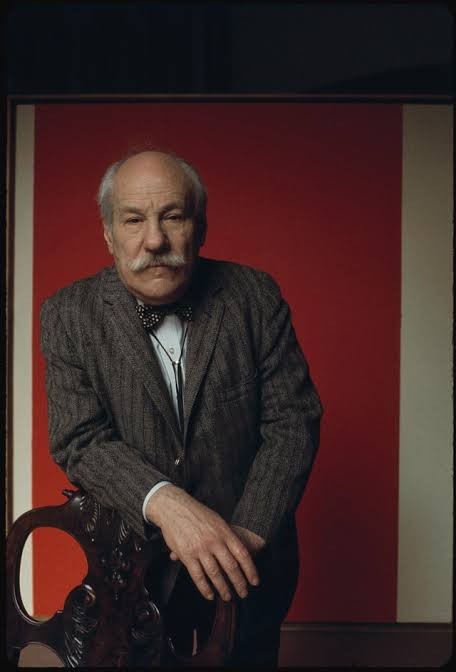
Barnett Newman (New York, January 29, 1905 – ibid., July 4, 1970) was an American painter and sculptor. Barnett Newman was the pseudonym of Baruch Newman. He is regarded as one of the leading figures in Abstract Expressionism and one of the most important Color Field painters.
Life and Work Newman was born the son of a Jewish immigrant from Poland. He studied philosophy in his hometown and worked in his father’s garment factory. Beginning in 1930, he created paintings in a sort of expressionist style, but he destroyed all of these works.
In the 1940s, he created his first surrealist works, which, in his own words, became increasingly mature over time. He characterized this style with large swaths of color separated by vertical lines; Newman called these lines “zips.” In his early works featuring these “zips,” the colors were variegated, but later they became pure and uniform. When Newman painted the “Onement” series in 1948, he considered it his most mature style. Starting in 1943, he published several art manifestos with Mark Rothko and Adolph Gottlieb in which the three painters advocated for a universal abstract art imbued with the drama that is also present in life itself. During those same years, Newman also joined the artist group known as the “New York School,” founded by Robert Motherwell.
In 1950, Newman held his first solo exhibition, which was so poorly received that he withdrew from the art world until 1958. However, both the criticism and his self-criticism fostered his development, enabling him to present an exhibition of his body of work in 1958.
The “zips” remained a constant feature in Newman’s work and life.
Most of Newman’s works can be described as abstract, and many of them were originally untitled. The works to which he later gave titles often had a Jewish theme. Examples include the works “Adam and Eve,” “Uriel,” and “Abraham.” The work “Onement” also refers to the Jewish view of the unity of God. Edward van Voolen writes that Newman draws heavily on abstract monotheism, as the Jewish religion can be regarded.[1] According to Van Voolen, the painting “The Name I”—consisting of four vertical red stripes on a gray background—refers to the four letters of God’s name. Incidentally, Abraham was his father’s name. The Kabbalah, mythology, and early American cultures were his sources of inspiration.
Newman’s later works, such as the series “Who’s Afraid of Red, Yellow, and Blue,” consist of pure colors, often on very large canvases.
Discover more at Kunstuitleen.nl: Collection · Artists · How it works · Art for business