Category B
Artist
Anton Heyboer
Rent or buy art by Anton Heyboer? At Kunstuitleen.nl you can view 2 works by Anton Heyboer and try it free at home — with delivery and a hanging service throughout the Netherlands.
2 artworks in our collection
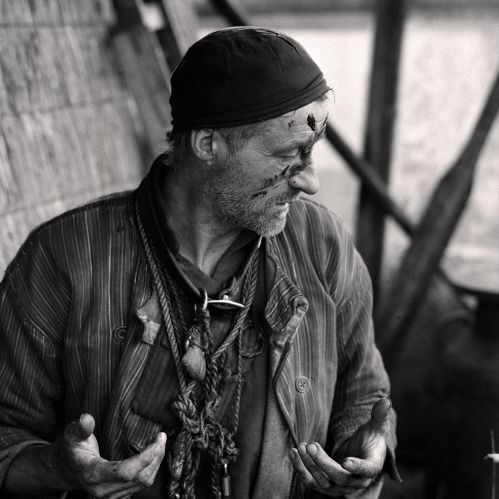
Anton Heijboer (1924–2005), who said, “Just call me the Robin Hood of art,” was born in 1924 in Sabang, in the former Dutch East Indies, the son of a mechanical engineer. The family soon moved to Haarlem, where they lived until 1925. The Heijboer family then seemed to embark on a marathon of moves through cities in the Netherlands, with stops along the way in New York and Curaçao. Their son Anton received technical training as a mechanical engineer. He also learned welding and metalworking. He became a drilling foreman. In 1942, the Heijboers settled in Haarlem, where Anton was arrested by the Germans a year later and sent to work in Berlin. After seven months, he returned gravely ill. His experiences in the labor camp were of great significance to the development of his artistry. He wrote about it himself: “The concentration camp was no worse than my parents’ home, and society, to me, is no worse than both—it’s just too uncreative.” He taught himself etching and produced unabashedly kitschy art to earn his daily bread. After the war, he left his parents’ home and moved to Drenthe, lived in the south of France for a few months, and in 1951 had himself admitted to the psychiatric hospital in Santpoort. He stayed there for a few months. His turbulent lifestyle was reflected in a number of marriages. In 1961, he found the peace he was seeking in Den Ilp. And from that moment on, Heijboer and his brides became increasingly well-known. The Heijboer Farm became a tourist attraction, and a small shop opened across the street where the artist’s work was offered for sale. This marked the beginning of a series of expansions on the property. Things went well for a long time, but residents began to grumble as the municipality forced them to tear down their illegal structures. Heijboer became a political issue in the early 1990s. The Gemeentebelangen party emerges as a thorn in the side of the Heijboer family, because successive politicians keep getting the impression that Heijboer is allowed to do more than the ordinary residents of the village. This was somewhat justified, as evidenced by a statement made by Mayor Kerkhoven in 1987: “Distinction must be possible.” The house slowly disappears behind wooden fences. Over the years, the graphic artist’s number of wives rises to five: Petra, Lotti, Joke, Marike, and Maria, in no particular order of marriage. His artistic output increases. Recently, an Anton Heijboer Gallery opened in the center of Groningen, run by Tim Muskee, an art dealer and fan. Heijboer’s name is also well-established abroad. His work has been acquired by museums in the United States, Peru, Germany, Switzerland, and England. A museum in Chicago has named a gallery after him.
Artwork by Anton Heyboer
Category B
Discover more at Kunstuitleen.nl: Collection · Artists · How it works